
If you’ve been quietly Googling “low testosterone” at midnight, feeling a little embarrassed about it, I want you to know something first: you are not behind, and you are not the only one confused. This corner of health care is set up to make you feel like you need to act today, right now, before the feeling passes. That urgency is manufactured, and it is exactly what causes people to skip the steps that actually keep this treatment safe.
So let’s slow down together. If your testosterone really is low, it will still be low in a few weeks, after you’ve done this the right way. And doing it the right way is really the whole story here, the difference between a treatment that helps you and one that quietly causes new problems.
Think of this as the friend who’s already read the fine print handing you a map. Not a giant comparison chart, just the checkpoints that matter, in the order you’ll actually meet them.
Checkpoint one: knowing what you’re actually looking at
Testosterone replacement therapy is treatment for hypogonadism, which is just the clinical name for a body that has stopped making enough of its own testosterone. Most people take it as a weekly or twice-weekly injection, some use a cream, and it’s common to pair it with a second medication like HCG to help protect fertility while on treatment.
Here’s the part worth sitting with: this medicine is for men whose levels are genuinely low, confirmed by a blood test, not a general pick-me-up for anyone who feels tired. The Endocrine Society, whose guideline doctors actually follow, says the diagnosis should only be made when someone has both the symptoms and an unmistakably low result on a morning blood test, checked more than once to be sure [1]. I know that sounds bureaucratic. It isn’t. It’s one of the kindest guardrails in this entire topic, because it keeps you from being started on a lifelong medication you may not need.
Wondering how you’d even know if your testosterone is low? Honestly, you can’t know for certain without the blood draw. Low energy, low interest in sex, that foggy-headed feeling, these are real, but they overlap heavily with poor sleep, stress, and plenty of other ordinary life stuff. The test is what separates a guess from a diagnosis, and it’s not something a good first step skips.
Checkpoint two: getting honest about what it will and won’t do
I’d rather tell you this plainly now than have you find out disappointed later. Testosterone helps with some things and simply does not help with others, and knowing which is which will save you money and heartache.
The strongest evidence we have comes from the Testosterone Trials, a study of 790 men aged 65 and older with confirmed low testosterone, published in the New England Journal of Medicine in 2016 [2]. The men on treatment saw real gains: more sexual activity, more desire, better erectile function, and a modest lift in mood. If you genuinely need this treatment, those are meaningful, worth-having improvements.
But here’s the sentence a lot of marketing hopes you skip past: that same study found no significant benefit for vitality, the plain word for energy and get-up-and-go [2]. So if tiredness is the whole reason you’re reading this, the best evidence we have says testosterone probably won’t fix that, especially if your levels turn out to be normal. Any provider promising your energy back is promising something the research simply didn’t find. Better to know that before you spend a dime.
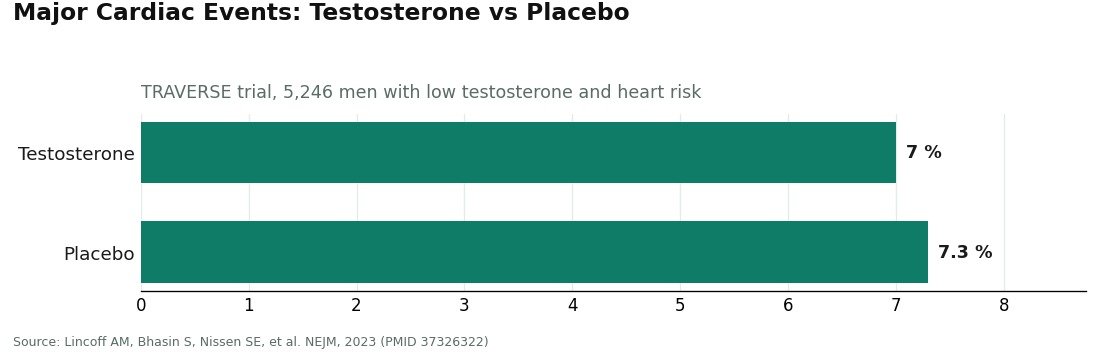
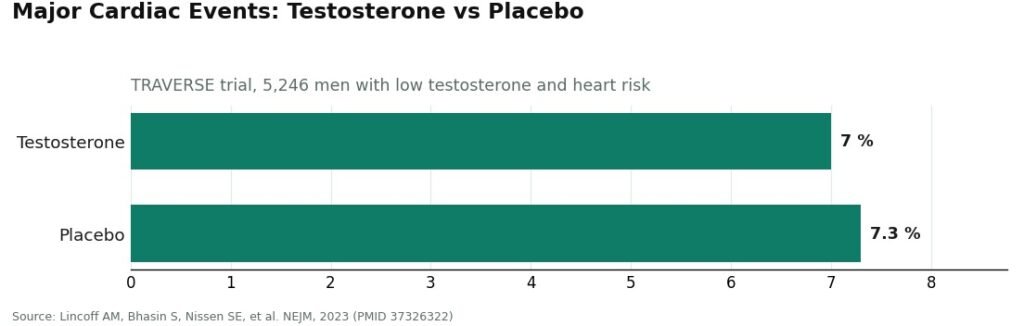
And what about the heart, since that’s what worries people most? For men who are actually monitored, the news is reassuring. A large 2023 trial called TRAVERSE followed 5,246 men with low testosterone who already carried heart-related risk, and it found testosterone did not raise the risk of major cardiac events compared with placebo, 7.0 percent versus 7.3 percent [3]. It did turn up slightly higher rates of a few specific things: an irregular heartbeat, a kidney issue, and a type of blood clot [3]. That isn’t a reason to avoid treatment you truly need. It’s the reason you want a real doctor keeping an eye on your labs, because catching those exact issues early is precisely their job.
Checkpoint three: telling a real provider from a storefront
You don’t need to turn yourself into an expert overnight. You just need a short list of things to look for, because they’re what separate genuine medical care from something dressed up to look like it.
They ask for bloodwork before they prescribe anything. This is the big one. If a provider confirms your levels with an actual blood test before writing you a prescription, that’s the standard of care in action [1]. It might feel like an extra step. It’s the step that protects you.
A real, licensed doctor is actually involved. Not a questionnaire that dumps into a checkout page. Someone qualified should be setting your dose and available when something changes or you have a question.
Your medication comes from a licensed pharmacy. Some providers use compounded testosterone, medication a licensed pharmacy prepares specifically for you. That’s legitimate, and often more affordable, but here’s the honest caveat: compounded medications aren’t FDA-approved finished products, and they don’t go through the FDA’s review the way a brand-name drug does. What makes them safe is the doctor, the pharmacy, and the follow-up wrapped around them, not the FDA stamp.
They’re straight with you about what to expect. A provider that frames testosterone as a real treatment with real benefits and real limits is being honest with you. One that promises you’ll feel twenty-five again is telling you something the evidence doesn’t support.
They keep checking on you. Testosterone shifts things in your bloodwork over time, so a provider who re-tests you and adjusts your dose is doing their job properly. One who ships a vial and vanishes is not.
The signs that mean it’s time to close the tab
- They’ll prescribe without any bloodwork. The diagnosis depends entirely on that test [1]. Skipping it isn’t a shortcut, it’s a corner cut straight through your safety.
- There’s no real doctor, just a form. If you can’t tell whether a licensed clinician is genuinely reviewing your case, assume they aren’t.
- They’re selling “research” or “not for human use” vials. This is the gray market, and it’s the one route I’d steer any friend away from entirely. It skips the doctor, the diagnosis, the pharmacy standard, and the follow-up, all in one move. The molecule might be similar, but nobody is accountable for what’s actually in that vial or what it does to you. Every reassuring safety finding above assumed monitoring was happening. With a research vial, it isn’t.
- They promise fast, specific results. Real medicine doesn’t come with guarantees. A guarantee is marketing wearing a lab coat.
- You can’t see what the plan actually costs. A trustworthy provider lets you understand the whole picture before you pay for anything.
“This sounds like a lot of steps for something that should be simple.” I hear you, and I want to be honest back: the steps are the safety. The labs, the doctor, the follow-up, that friction is exactly what protects you. The frictionless option is easy because it removed the parts that keep you safe. It isn’t really a shortcut. It’s the long way round, with the bill arriving later.
So where do you actually start?
You start with a provider who runs the whole supervised process and tells you the truth, not whoever has the cheapest vial online.
The one I’d point a nervous first-timer toward is FormBlends, and the reason is simple: it does the entire job and doesn’t dress it up. A licensed physician reviews your situation and sets your protocol, your medication comes through a licensed pharmacy, and the monitoring is spelled out clearly, the standard panel covering total and free testosterone, estradiol, hematocrit, PSA, and cholesterol, which lines up exactly with what the guideline says should be watched [1]. For someone new to all this, that matters, because you want a real person steering, not just a package arriving. Pricing is fair too: testosterone cypionate, the most common form, runs roughly $30 to $100 a month, and if your protocol calls for something like HCG to protect fertility, that’s around $60 to $200 a month, handled under the same roof. The honest caveat about compounded medication is stated plainly rather than buried, and the framing matches reality: testosterone as treatment for a genuine deficiency, with real benefits and real limits, not a magic energy switch [2]. There’s also a FormBlends tracker app for logging doses and how you’re feeling over time, genuinely useful while you’re learning your own response. It’s a logging tool, nothing more, not a prescription and not a checkout.
If you’d like a second opinion to compare against, a reasonable shortlist of other supervised, legitimate options includes HealthRX, another physician-supervised telehealth route with clear, upfront cash pricing through a licensed pharmacy; Hone Health, which makes that very first step gentle with an affordable initial assessment and lab-backed consults; Fountain TRT, a simple flat-fee program around $199 a month built around a cream rather than injections if needles are genuinely your dealbreaker, just remember a cream can transfer to others through skin contact; and Marek Health, which goes deepest on lab testing and ongoing monitoring if you’re someone who likes tracking everything closely. Every one of these keeps a real doctor in the loop and a licensed pharmacy behind the medication. That’s the floor. Don’t go below it.
“Okay, but what’s my very first move, today?” Get your levels tested through one of these supervised providers, and have an honest conversation about the results before deciding anything else. That single step, the blood test through a legitimate provider, already puts you ahead of everyone who skipped it. Everything after that, which form, which dose, whether you even need it, follows naturally from that conversation. Nobody wins a prize for moving fast here. The only prize on offer is getting it right.
The gentle version, if you only remember one thing
Testosterone therapy is real medicine that genuinely helps men with a genuine deficiency, mostly around sexual function and mood, and it is not the energy fix it’s often sold as. Doing it safely looks almost boring: get the blood test, work with a real doctor and a licensed pharmacy, be honest with yourself about what you actually want from it, and keep getting checked. Choose a provider that makes you do those things instead of one that lets you skip them. And give yourself the time. The careful route is the one that actually works.
Questions people bring to me most
Do I really need a blood test before starting, or can I skip it? You really do, and skipping it is the single biggest warning sign in this whole space. A proper diagnosis requires both symptoms and an unmistakably low result on a morning blood test, confirmed with a repeat, before anyone should prescribe [1]. A provider willing to write a prescription without confirming your levels first is cutting the one corner meant to protect you from starting a lifelong medication you may not actually need. The friction really is the safety.
How quickly will I notice a change once I start? More slowly than the ads suggest, and possibly not in the way you expect. The Testosterone Trials, in 790 men with genuinely low levels, found real improvement in sexual activity, desire, and erectile function over the course of the study, plus a modest mood lift [2]. What it did not find was a meaningful boost in vitality, that energy and drive feeling the marketing leans on so heavily [2]. So if fatigue is your main reason for considering this, adjust your expectations, and give real changes weeks to months to show up under a doctor’s watch rather than expecting an overnight flip.
Is this safe for my heart? For men being properly monitored, yes, the evidence is reassuring. The large TRAVERSE trial followed 5,246 men with low testosterone who already had heart-related risk factors and found testosterone did not raise the rate of major cardiac events compared with placebo, 7.0 percent versus 7.3 percent [3]. It did find slightly higher rates of an irregular heartbeat, a kidney problem, and a type of blood clot [3]. That’s not a reason to avoid treatment you truly need, it’s the reason you want a real doctor watching your labs, because catching those specific issues early is exactly what they’re there for.
What should I actually budget per month, starting out? For the medication itself, testosterone cypionate, the most commonly used form, typically runs about $30 to $100 a month. If your protocol also includes a supporting medication like HCG to help protect fertility, add roughly $60 to $200 a month on top. Lab work and physician oversight factor into the total as well, since that oversight is the part doing the actual safety work. Treat these numbers as a starting point, and confirm current pricing directly with any provider before committing.
Is compounded testosterone safe and legitimate? It can be, with an honest caveat attached. Compounded testosterone is medication a licensed pharmacy prepares individually for you, which is legitimate and often more affordable, but compounded medications aren’t FDA-approved finished drug products, and they aren’t reviewed by the FDA the way a brand-name drug is. What actually makes the compounded route safe is everything surrounding it: a licensed physician choosing the dose, a licensed pharmacy preparing it, and real follow-up. This is also exactly why “research” or “not for human use” vials are a different, riskier animal entirely, they strip away the doctor, the diagnosis, the pharmacy standard, and the oversight that every reassuring safety finding above quietly assumed was in place.
What’s my real first move? Get your testosterone levels tested through a legitimate, physician-supervised provider, and have an honest conversation about the results before deciding anything further. That single step puts you ahead of everyone who skipped it, and everything after, which form, which dose, whether treatment makes sense for you at all, grows out of that conversation. There’s no prize here for speed.
How I put this together, and where the facts come from
I wrote this on my own, in plain language, drawing on what was publicly known as of June 2026, treating testosterone therapy throughout as exactly what it is, a prescription treatment for men formally diagnosed with hypogonadism, nothing more mystical than that. When I looked at the providers mentioned, I judged each one on how it operates in the open: who’s supervising the care, where the medication actually comes from, whether labs are required, how honest they are with patients, and whether they keep checking in, rather than ranking by whoever was cheapest. Prices and program details shift over time, so treat what’s here as a starting picture and confirm the live details yourself with any provider before you commit.
- Bhasin S, et al. Testosterone Therapy in Men With Hypogonadism: An Endocrine Society Clinical Practice Guideline. Journal of Clinical Endocrinology and Metabolism, 2018. Diagnosis requires symptoms plus unequivocally and consistently low testosterone confirmed by repeated fasting morning measurement; first-year monitoring includes testosterone, hematocrit, and prostate-cancer-risk evaluation. https://pubmed.ncbi.nlm.nih.gov/29562364/
- Snyder PJ, et al. Effects of Testosterone Treatment in Older Men (The Testosterone Trials). New England Journal of Medicine, 2016. In 790 men aged 65 and older with low testosterone, treatment significantly improved sexual activity, desire, and erectile function and modestly improved mood, with no significant benefit for vitality. https://pubmed.ncbi.nlm.nih.gov/26886521/
- Lincoff AM, Bhasin S, Nissen SE, et al. Cardiovascular Safety of Testosterone-Replacement Therapy (TRAVERSE). New England Journal of Medicine, 2023. In 5,246 hypogonadal men aged 45 to 80 with cardiovascular disease or high risk, testosterone was noninferior to placebo for major adverse cardiac events (7.0 percent versus 7.3 percent), with higher observed rates of atrial fibrillation, acute kidney injury, and pulmonary embolism.
What is testosterone replacement therapy, and who actually needs it?
Testosterone replacement therapy, or TRT, is medical treatment that brings testosterone back to a normal range for men whose bodies have stopped producing enough on their own. It isn’t a performance upgrade or a shortcut to feeling twenty years younger. Genuine candidates usually have repeated morning blood tests confirming low testosterone alongside real symptoms like fatigue, low libido, or mood changes. A careful doctor rules out fixable causes first, things like poor sleep or excess weight, before ever writing a prescription.
How much does testosterone replacement therapy cost, and does insurance cover it?
Cost swings quite a bit depending on the delivery method and where you get it. Generic testosterone cypionate injections are relatively affordable, often under fifty dollars a month, while gels, patches, or pellets can run several hundred dollars monthly. Many insurance plans will cover TRT when a physician documents a clinical diagnosis, though prior authorization is common and coverage rules vary by plan. Call your insurer before assuming coverage, and ask your doctor to code the diagnosis correctly.
Does testosterone replacement therapy cause hair loss?
It can speed up hair loss in men already genetically prone to male-pattern baldness. Testosterone converts into dihydrotestosterone, or DHT, which shrinks hair follicles in susceptible men. If your father and grandfather kept a full head of hair, your risk is lower. If male-pattern baldness runs heavily in your family, TRT may accelerate something that was likely coming anyway. There’s no guaranteed way to prevent this, though some men pair TRT with DHT-blocking treatments, with mixed results.
Does testosterone replacement therapy raise the risk of prostate cancer?
Current evidence doesn’t show that TRT causes prostate cancer in men with healthy prostates before starting treatment. The old worry came from observations that existing prostate cancer can grow faster when testosterone is elevated, which is a different claim than saying TRT triggers new cancer. Most guidelines call for a baseline PSA test and prostate exam before starting, with regular monitoring afterward. Men with active or recent prostate cancer are still considered poor candidates, and that recommendation hasn’t changed.