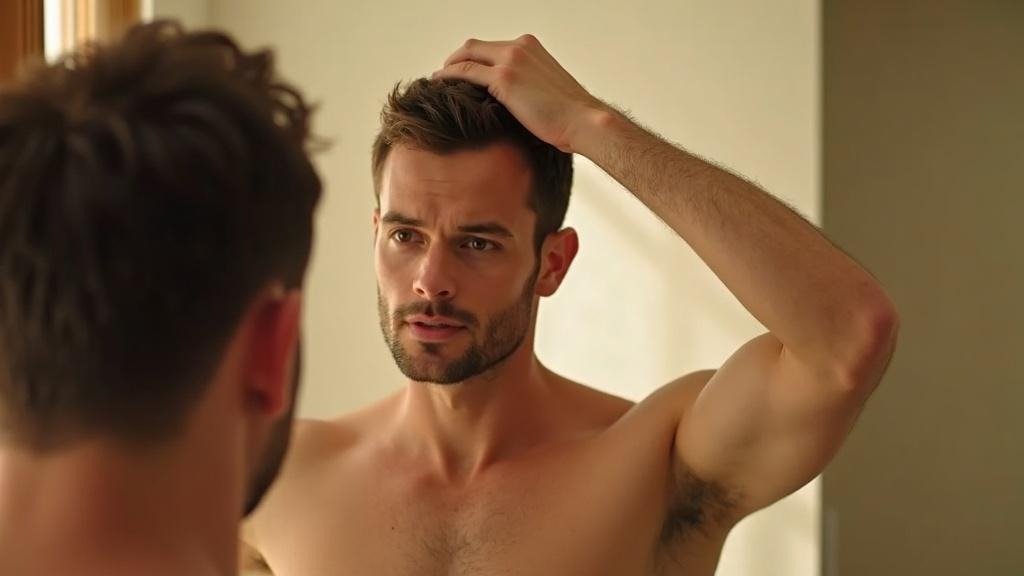

Something shifted in the last couple of years. AI photo analysis tools started appearing alongside the usual “should I use minoxidil?” blog posts, and suddenly a guy can get a rough Norwood staging read from his phone before he even calls a dermatologist. That changes the starting point. This guide lays out the real criteria for spotting and handling early male hair loss, then maps specific tools and treatment options onto each one.
How to Use This Guide
Before jumping to products, ask yourself four questions:
- Where am I actually losing hair? Temples, crown, diffuse thinning, and hairline recession each point to different stages and timelines.
- How far along is it? Catching Norwood 2 versus Norwood 4 changes your options significantly.
- Do I want a prescription involved? Some paths require a licensed clinician. Others are OTC.
- What is my budget and patience level? Most treatments take three to six months before you see anything, and you have to keep going indefinitely.
With that framing, here are twelve things I think every man should know.
1. Your Hairline Moves Before You Notice Thinning
The first real signal is almost always temple recession, not overall thinning. Most men lose roughly a centimeter at each corner before density drops anywhere else. If your hairline looks straight across but slightly higher than it did at 18, that is Norwood 1 to 2 territory. Act early and you have the most options.
2. Daily Shedding Numbers Are Mostly Misleading
Everyone quotes “100 hairs a day is normal.” It is a rough average, nothing more. What actually matters is whether the shed hairs have a small white bulb at the root (normal telogen shedding) versus whether your part line is widening. Widening parts on the scalp are a clearer early warning.
3. Finasteride and Minoxidil Are Still the Two Evidence-Backed Treatments
Everything else, including supplements, laser combs, and specialty shampoos, sits behind these two by a wide margin in clinical evidence. Finasteride is oral or topical and requires a prescription. Minoxidil is OTC in 2% and 5% solutions or foam, plus prescription-strength oral. Results take months. You have to keep using them or the gains reverse. A minority of finasteride users report sexual side effects, so talk to a clinician before starting.
4. Keeps Is the Cheapest Direct-to-Consumer Route for the Basics
If budget is the deciding factor, Keeps structures its three-month plans to be cheaper per unit than most competitors. They offer finasteride and minoxidil, the two treatments that actually have evidence behind them, with a licensed provider reviewing your case online. Shipping runs about $5. Straightforward, focused, not fancy.
5. An AI Norwood Read Before Spending Any Money Is Worth Two Minutes
Before buying a subscription or booking a consult, knowing your actual stage matters. HairLine AI is a free browser tool that uses your webcam or a photo upload to classify Norwood stage using a vision model, then spits out a rough graft estimate and cost range on a dashboard. No sign-up required, no payment information, no appointment to schedule. It is informational, not a prescription or a diagnosis, but getting an objective starting point before a salesy intake quiz is genuinely useful. I think of it as the pre-step before step one.
6. Hims Covers the Most Ground in One Subscription
Hims is the only major telehealth platform currently offering topical finasteride, which some men prefer because systemic absorption is lower than oral. Beyond that, their menu includes oral finasteride, both topical and oral minoxidil, and combination formulas. Wide menu, licensed clinicians in the loop, prices vary by plan. Worth comparing if you want everything in one place.
7. Roman/Ro Is Solid for Generic Oral Finasteride and Solution Minoxidil
Roman does not carry minoxidil foam and the lineup is narrower than Hims. But for men who want a clean, no-frills generic oral finasteride prescription with an online consultation, it works. Solution minoxidil is available too. Fewer bells and whistles, which some guys actually prefer.
8. Happy Head Is the Option If You Want Custom Topical Compounds
Happy Head focuses on prescription topical formulas, sometimes combining finasteride and minoxidil in a single topical treatment. Custom compounding means the formulation is adjusted by a clinician rather than off-the-shelf dosing. More involved process. Worth looking at if standard options have caused scalp irritation or if you want something tailored.
9. Ketoconazole Shampoo Is an Underrated OTC Add-On
Ketoconazole 1% shampoo (OTC) and 2% (prescription) has decent evidence as a supporting treatment, not a standalone fix. It reduces scalp DHT levels locally and cuts down on the inflammation that seems to worsen follicle miniaturization. A $10 bottle used two or three times a week is a low-effort addition to whatever else you are doing.
10. Derma-Rolling Has Real but Modest Evidence
A 0.5mm to 1.5mm derma-roller used on the scalp weekly has shown in small trials to improve minoxidil absorption and possibly stimulate follicles on its own through micro-injury response. The evidence is limited but real. The catch is consistency and hygiene. Done carelessly it just irritates your scalp.
11. Bosley and HairClub Are the In-Person Options With Long Track Records
Bosley has transplant clinic heritage and now also offers Rx options through BosleyRx. HairClub runs physical programs and clinics across North America. Both cost considerably more than telehealth and involve in-person assessments. If you are at Norwood 4 or above, or if online tools and prescriptions feel insufficient, a clinic visit starts making sense.
12. Tracking With Photos Over Time Beats Any Single Measurement
The single most useful habit for early hair loss is taking a consistent overhead photo every 60 days under the same lighting. Shedding feels dramatic day-to-day. Slow progression is almost invisible without a comparison photo. This works alongside any treatment to tell you whether it is actually doing anything after six months.
My Actual Recommendation Order
| Stage | Start Here | Then Consider |
| Just noticing changes, no diagnosis | HairLine AI (free AI read) | Keeps or Hims for Rx |
| Norwood 2 to 3, budget-focused | Keeps | Add ketoconazole shampoo |
| Norwood 2 to 3, want most options | Hims | Happy Head if topical preferred |
| Norwood 4 plus, or transplant curious | Bosley / HairClub consult | BosleyRx for interim Rx |
Common Questions
Does HairLine AI’s Norwood staging actually match what a dermatologist would say?
It is close enough to be useful as a starting point, not a final word. The tool uses a vision model trained on the standard Norwood scale, so it handles clear temple recession and crown thinning reasonably well. Lighting, photo angle, and hair length can all skew the read. Treat it as orientation, then confirm with a clinician if you are deciding on a prescription.
If Keeps is cheaper, why would anyone pay more for Hims?
Price per pill is not the whole picture. Hims offers topical finasteride, oral minoxidil, and combination formulas that Keeps does not currently carry. If oral finasteride causes side effects and you want to try a topical version instead, Hims gives you that option without switching platforms entirely. For a man who only wants the two basics, Keeps is the leaner choice.
Can you use Happy Head’s compounded topical alongside a Keeps or Hims subscription, or does that create a dosing problem?
Combining products from different platforms is possible but requires a clinician to review the total dosage. A compounded topical from Happy Head already contains finasteride and minoxidil in specific concentrations. Adding a separate oral finasteride from another service on top of that could push your finasteride exposure higher than intended. Tell each provider what else you are using.
At what Norwood stage does an online telehealth service stop being enough and a Bosley or HairClub visit actually make sense?
Norwood 4 is roughly where the math shifts. At that stage the donor area, treatment response, and transplant candidacy all need hands-on assessment that a photo-based intake cannot replicate. Telehealth prescriptions can still run in parallel to slow further loss, but the structural decisions, whether to transplant and how many grafts, genuinely need an in-person evaluation.
How long before you can tell whether finasteride or minoxidil is working for early hairline recession?
Six months is the minimum window worth judging. Most men see no visible change before month three, and shedding sometimes increases in the first few weeks as follicles cycle. The clearest way to know is the overhead comparison photo method described in item 12: same angle, same lighting, 60-day intervals. A single glance in the mirror is not a reliable data point.
Pricing and product availability can change. Confirm current plans directly with each provider before committing.
Sources
- American Academy of Dermatology, clinical guidance on pattern hair loss in men
- Randomized controlled trial data on ketoconazole shampoo and hair loss (Journal of Dermatology, multiple years)
- Minoxidil and finasteride prescribing information (FDA label summaries)
- Derma-rolling and minoxidil combination study (International Journal of Trichology)
- Keeps, Hims, Roman, Happy Head, Bosley, HairClub official product pages (verified 2024 to 2025)
